



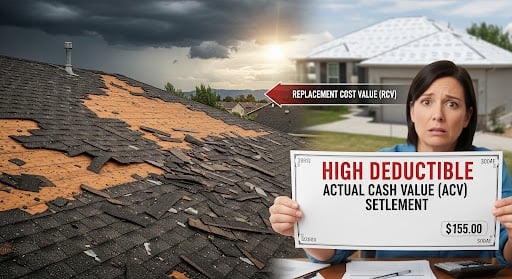
When shopping for a new policy or reviewing your annual renewal, you need to look past the monthly premium. Understanding the fine print regarding how your roof is covered can save you thousands of dollars when the next storm hits. As hail seasons become more intense, insurance companies are frequently updating their policies, often in ways that can leave homeowners underinsured or facing massive out-of-pocket costs.
The Wind and Hail Deductible Check
In Colorado, many insurers no longer offer a flat $1,000 or $2,500 deductible for wind and hail damage. Instead, they have moved to percentage-based deductibles.
- Fixed vs. Percentage: A 1% or 2% deductible is based on the total insured value of your home, not the cost of the roof repair. If your home is insured for $600,000, a 2% deductible means you must pay $12,000 out of pocket before insurance pays a dime.
- Split Deductibles and Hail/Wind Exclusions: Ensure you check if your policy has a “split” deductible—one lower amount for standard claims (like a pipe burst) and a much higher amount specifically for wind and hail.
- The “Marring” Exclusion: Some policies now exclude “marring” or cosmetic damage to metal components like gutters, vents, and metal roofs. If the hail doesn’t create a “functional” hole, the insurance company may deny the claim entirely.
RCV vs. ACV: Knowing the Difference
- Replacement Cost Value (RCV): This is the gold standard. RCV covers the actual cost to replace your roof with a new one of similar quality at today’s market prices. While they may withhold a portion of the payment as “recoverable depreciation” until the work is finished, you eventually get the full amount needed for the project minus your deductible.
- Actual Cash Value (ACV): An ACV policy only pays what your roof is worth at the time of the damage. This means they take the replacement cost and subtract “depreciation” based on the age and condition of the roof.
- The Risk of ACV: If you have a 15-year-old roof on an ACV policy, the insurance company might only pay 50% of the replacement cost. You would be responsible for the other 50% plus your deductible.
Alternative Solutions for Deductible Expenses
With deductibles rising, new “deductible gap” insurance products have entered the market to help homeowners manage the financial shock of a claim.
- Sola Insurance: Sola insurance provides supplemental policies specifically designed to cover your primary insurance deductible. If a storm hits and you have a $12,000 deductible, a Sola policy can pay that amount directly to you, effectively resulting in a zero-dollar out-of-pocket expense for your roof replacement.
- Non-Recoverable Depreciation Check: If you are forced to accept an ACV policy, you may be responsible for non-recoverable depreciation. Some deductible gap policies, like Sola, can be used to cover this specific cost in addition to the deductible.
- How a High Deductible Saved Me Money: I’ll share what I did personally: I raised my own wind/hail deductible to 2% to lower my monthly premium, then bought a Sola policy for $782.87/year to cover the gap. Net result: $2,813.65 in annual savings and I still have zero out-of-pocket exposure if a storm hits. I’m not an insurance agent and this isn’t advice, but when I found something that worked I figured it was worth sharing.
Watch for hidden traps like matching material exclusions and local building code requirements. Smart solutions, such as impact-resistant shingle credits, can help you avoid these costs while lowering your long-term premiums.
More Hidden Traps and Smart Solutions
- Ordinance or Law Coverage is Key: When a storm hits, your city or county may require you to rebuild to current building codes. If your policy doesn’t have adequate “Ordinance or Law” coverage, you could be on the hook for the difference. Always confirm your limits for this coverage.
- Check for a Matching Materials Exclusion: If only a portion of your roof is damaged and the existing shingle is discontinued or unavailable, some policies will only cover replacing the damaged part, leaving you with a mismatched, patchwork roof. The “matching materials” clause dictates whether the insurer must replace the entire roof for a uniform look.
- Impact-Resistant Shingle Credits: Many Colorado insurers offer significant discounts or “credits” if you install impact-resistant (Class 4) shingles. While the upfront cost is higher, the long-term premium savings can offset the expense, and the roof is more durable against hail.
The best way to protect yourself when a storm hits is to know your roof’s condition before you file a claim. If you’re a past customer and want a complimentary roof assessment, give us a call. We’ll document what we see so you’re not starting from scratch when the adjuster shows up.